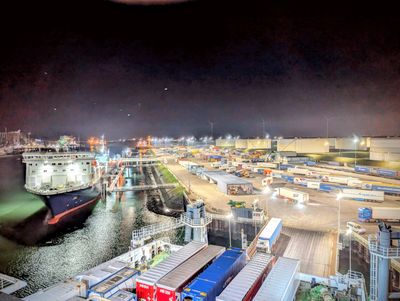
Security Skills Training visit to Rotterdam 2025
ISPS Compliance & Ferry Options Rotterdam
How the ISPS Code is implemented at Rotterdam’s Europoort (Europe) Ferry Terminal — and what that means for sailings to the UK
Rotterdam’s ferry and freight terminals are among Europe’s busiest gateways — and because they move people, vehicles and high-value cargo between the Netherlands and the UK, security isn’t an afterthought. The International Ship and Port Facility Security (ISPS) Code (the global rulebook adopted after 9/11) is the legal backbone that governs port and ship security. Below I’ll explain how the ISPS Code is implemented in Rotterdam (with a focus on Europoort / the Europe ferry terminal), what practical measures travellers and drivers will actually encounter, and the main routes from Rotterdam to the UK with typical crossing times.
ISPS in a nutshell
The ISPS Code requires both ships and port facilities to:
- perform a risk assessment,
- prepare and maintain a port facility security plan (PFSP),
- and operate under a designated Port Facility Security Officer (PFSO) and a Port Security Authority (PSA).
The competent authority (national government/port authority) reviews and approves those plans and coordinates enforcement with police, customs and other agencies.
How Rotterdam applies the ISPS Code (what’s actually done)
1. Risk assessments and approved security plans
For every terminal handling sea-going vessels — including ferry terminals at Europoort — the Port of Rotterdam Authority and the national competent authority require a documented risk assessment and a security plan that meets ISPS requirements. Those documents are reviewed by an ISPS evaluation team (police, customs, Port Authority) before approval. In short: the paperwork isn’t optional — it’s audited.
2. Roles and governance: PSO / PFSO / evaluation team
Rotterdam’s approach follows the ISPS structure: a Port Security Officer oversees port-level implementation, each terminal has a PFSO responsible for day-to-day measures, and an evaluation team advises on approvals and ongoing compliance. That multi-agency approach is standard practice in the port.
3. Access control, identification and vehicle management
Expect strict access control at ferry check-in and within the terminal area: vehicle lanes are segregated, drivers and foot passengers use different check-in points, and ID & ticket checks are enforced before embarkation. For freight drivers there are dedicated arrival/check-in flows and secure marshalling areas. These controls are both ISPS-driven and practical traffic-management measures.
4. Security levels, inspections and drills
ISPS uses security levels (1–3). Rotterdam terminal operators conduct routine inspections, searches and, where required, additional screening at higher security levels. The ISPS Code and Port of Rotterdam guidance also require regular drills and exercises (the guidance documents reference quarterly drills for port facilities). Expect port security exercises, CCTV coverage, lighting, fencing and patrols.
5. Staff training, vetting and liaison with border agencies
Terminal staff receive security training aligned with ISPS; critical staff are vetted; the terminal maintains liaisons with customs, police and border control — which is why passport control and fingerprint/photo procedures can slow disembarkation at busy times (a practical consequence of layered security).
6. Practical implications for travellers and hauliers
Arrive early: check-in times are enforced (many operators close check-in ~90 minutes before sailing).
Expect separation of flows: foot passengers, cars and freight have different lanes/doors.
Extra checks: enhanced document checks and occasional vehicle searches are carried out as needed.
Terminal location: Europoort is outside central Rotterdam (terminal address / logistics information is published by operators and port guides).
Rotterdam (Europoort / Europe Ferry Terminal) → UK: routes & typical crossing times
Below are the principal connections between the Rotterdam area (Europoort/Europoort-style ferry terminals) and the UK, with approximate crossing times and the operators most commonly used.
1. Rotterdam / Europoort ↔ Hull (P&O Ferries)
Operator: P&O Ferries (freight + passenger)
Typical crossing time: ~11–12 hours (overnight sailings are common). Many timetables show an average around 11h 30m–12h. Check-in windows and boarding for vehicles are clearly signposted at Europoort.
2. Rotterdam / Europoort (or Hook of Holland area) ↔ Harwich (Stena / freight services)
Operator: Stena Line (freight-focused Rotterdam–Harwich service; Hook of Holland–Harwich also operates historically)
Typical crossing time: Stena’s Rotterdam–Harwich freight crossings are around 8 hours (approx.); Hook of Holland ↔ Harwich passenger crossings (when available) are often in the 6½–7.5 hour range depending on the vessel/service. If you’re a freight driver you’ll commonly encounter the Rotterdam–Harwich freight clock around 8 hours.
3. Hook of Holland ↔ Harwich (Stena — passenger-oriented)
Operator: Stena Line (Hook of Holland to Harwich)
Typical crossing time: ~6h 30m–7h on the faster day sailings. Note this is Hook of Holland (Hoek van Holland), which is near Rotterdam but not the Europoort terminal itself; passengers sometimes travel to Hoek for quicker crossings.
4. Rotterdam / Europoort ↔ Tilbury (P&O Ferries)
Operator: P&O Ferries (freight + passenger)
Typical crossing time: ~9h (overnight sailings are common). Check-in windows and boarding for vehicles are clearly signposted at Europoort.
5. Rotterdam / Europoort ↔ Teesport
Operator: There is no current service to Rotterdam from Teesport.
Practical travel tips (security + sailing logistics)
Check operator check-in times (many close 90 minutes before departure). Arrive in the window they publish.
Have travel documents ready — passport, visas if applicable — because Dutch border procedures are sometimes thorough for disembarkation and vehicle checks.
Freight drivers should follow operator guidance for marshalling and vehicle lanes (separate freight terminals are common).
Expect security staff and CCTV: these are part of ISPS compliance and daily operations. If you see patrols, screening or fencing, that’s standard ISPS practice.
Final thoughts
Rotterdam’s terminals (Europoort/Europe Ferry Terminal area) implement ISPS through a mix of formal documentation (risk assessments and security plans), multi-agency review and day-to-day measures: access control, segregated vehicle/foot flows, routine drills and close cooperation with police and customs. For travellers and freight customers the visible result is a well-signposted, tightly controlled terminal where check-in rules and ID checks matter.
In comparison to the UK there are only subtle differences in the implementation of the ISPS code, this is a fact you would expect from an international standard.